
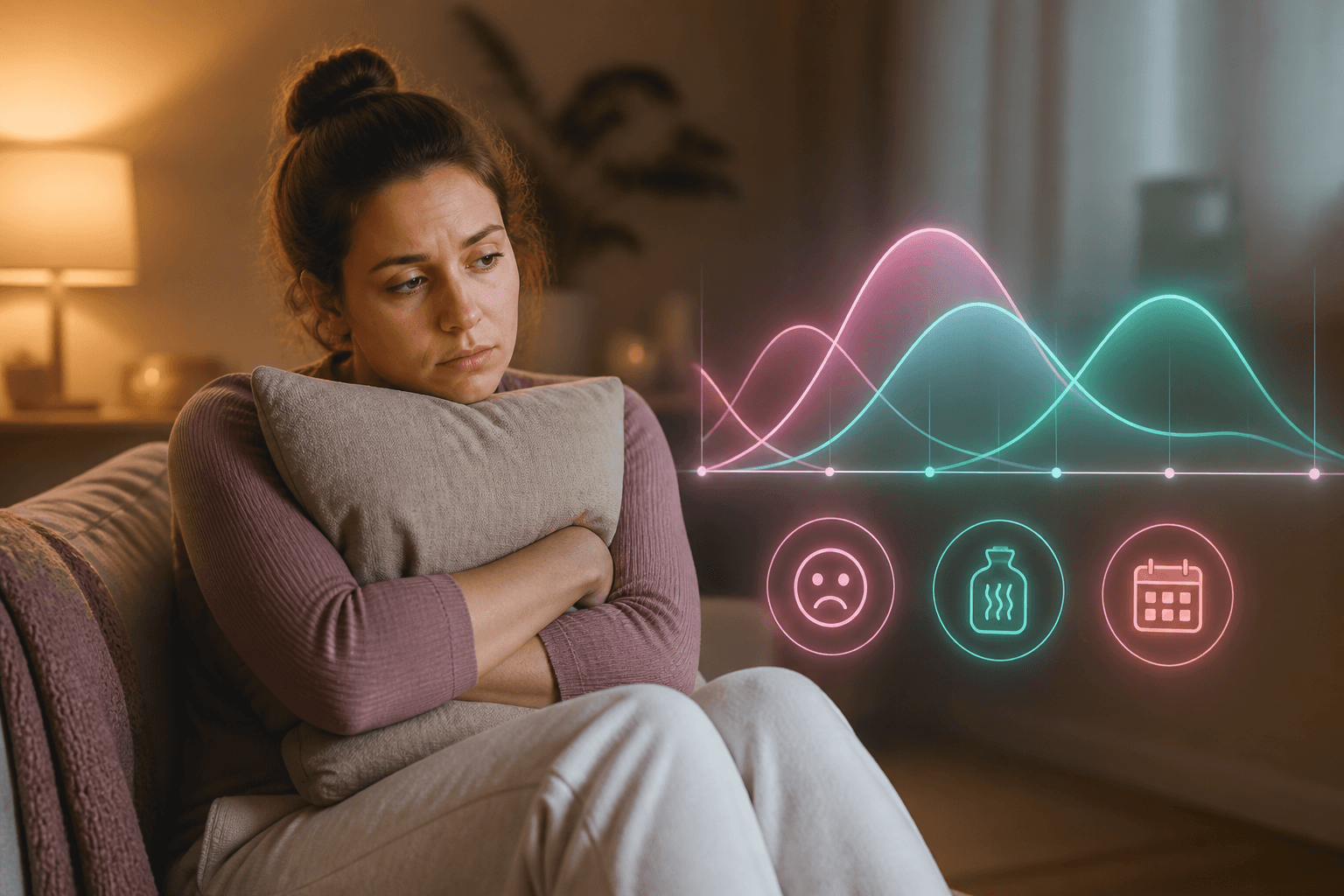
Women with severe premenstrual symptoms generally have completely normal hormone levels — the difference lies in how sensitively the brain responds to the normal monthly fluctuation. Here's what's actually happening, and what genuinely helps.
One of the more counterintuitive findings in this area of research is this: women with severe premenstrual symptoms, including the more intense form known as premenstrual dysphoric disorder (PMDD), generally have hormone levels that fall within a completely normal range. The issue isn't abnormal hormones — it's an abnormally sensitive response to entirely normal hormonal fluctuation.
PMS and PMDD Are a Difference in Degree, Not Just a Label
PMS covers a wide range of physical and emotional symptoms in the days before a period, most of which are manageable and don't significantly disrupt daily life. PMDD is a distinct, more clinically defined condition involving mood symptoms — such as intense irritability, anxiety, or depressive feelings — severe enough to meaningfully interfere with work, relationships, or daily functioning. It's not simply "worse PMS" in casual terms; it has specific diagnostic criteria and a different underlying pattern worth understanding on its own terms.
Why the Hormone-Level Explanation Doesn't Hold Up
Given how strongly PMDD symptoms track the menstrual cycle, it would be reasonable to assume hormone levels must be abnormal in some way. Research has consistently found otherwise: estrogen and progesterone levels in women with PMDD are typically indistinguishable from women without it. What differs is neurological sensitivity — particularly involving the brain's serotonin and GABA systems — to the normal rise and fall of these hormones. In effect, the same hormonal signal that most women process without much disruption triggers a disproportionate neurological response in women with PMDD.
Why Symptoms Cluster Specifically in the Luteal Phase
The luteal phase (the second half of the cycle, after ovulation) is when progesterone rises before falling sharply if pregnancy doesn't occur. One specific progesterone byproduct, allopregnanolone, normally has a calming effect on GABA receptors in the brain — but in some women, it appears to trigger the opposite, paradoxical response, contributing to the anxiety and irritability characteristic of this phase. This is a genuinely distinct mechanism from simple "hormonal changes," and part of why PMDD symptoms track so tightly with this specific window of the cycle.
The Full Symptom Range
- Physical symptoms: bloating, breast tenderness, headaches, joint aches, and fatigue.
- Emotional symptoms: irritability, anxiety, mood swings, tearfulness, and, in more severe presentations, feelings of hopelessness or intense sadness.
For PMDD specifically, it's the emotional symptoms — and their functional severity — that distinguish it, rather than the presence of physical symptoms alone.
Why Tracking Symptoms Properly Matters
Because premenstrual symptoms are, by definition, cyclical, a symptom diary kept across at least two full cycles is one of the most useful diagnostic tools available — confirming that symptoms cluster specifically in the luteal phase and resolve with menstruation, rather than reflecting a mood condition that's simply always present. This distinction matters, since ongoing depression or anxiety unrelated to cycle timing requires a different treatment approach than PMDD does.
What Helps for Typical PMS
- Calcium and vitamin D have reasonable evidence supporting a reduction in PMS symptom severity when intake is adequate.
- Reducing sodium, caffeine, and alcohol in the days before a period can ease bloating, irritability, and sleep disruption for many women.
- Regular aerobic exercise has a consistent, moderate effect on mood-related PMS symptoms specifically.
- Prioritizing consistent sleep in the luteal phase specifically, when sleep disruption tends to be more pronounced.
What Helps for PMDD Specifically
Because PMDD involves a distinct neurological sensitivity rather than simply "more PMS," it often responds to approaches specifically tailored to that mechanism:
- SSRIs are frequently used, but notably, some women with PMDD respond well to taking them only during the luteal phase rather than continuously throughout the cycle — a dosing pattern that reflects the condition's distinct, cycle-linked mechanism rather than functioning identically to how SSRIs are used for ongoing depression.
- Certain hormonal contraceptives, particularly those that suppress the natural cyclical hormone fluctuation, can reduce PMDD symptoms in some women by smoothing out the fluctuation that triggers the neurological response.
- Cognitive behavioral therapy has shown genuine benefit for the emotional symptoms of PMDD, complementing rather than replacing the approaches above.
Continue reading for free
Create a free account to keep reading — and connect with our trusted partner's licensed doctors whenever you need more than information.
Already have an account?