
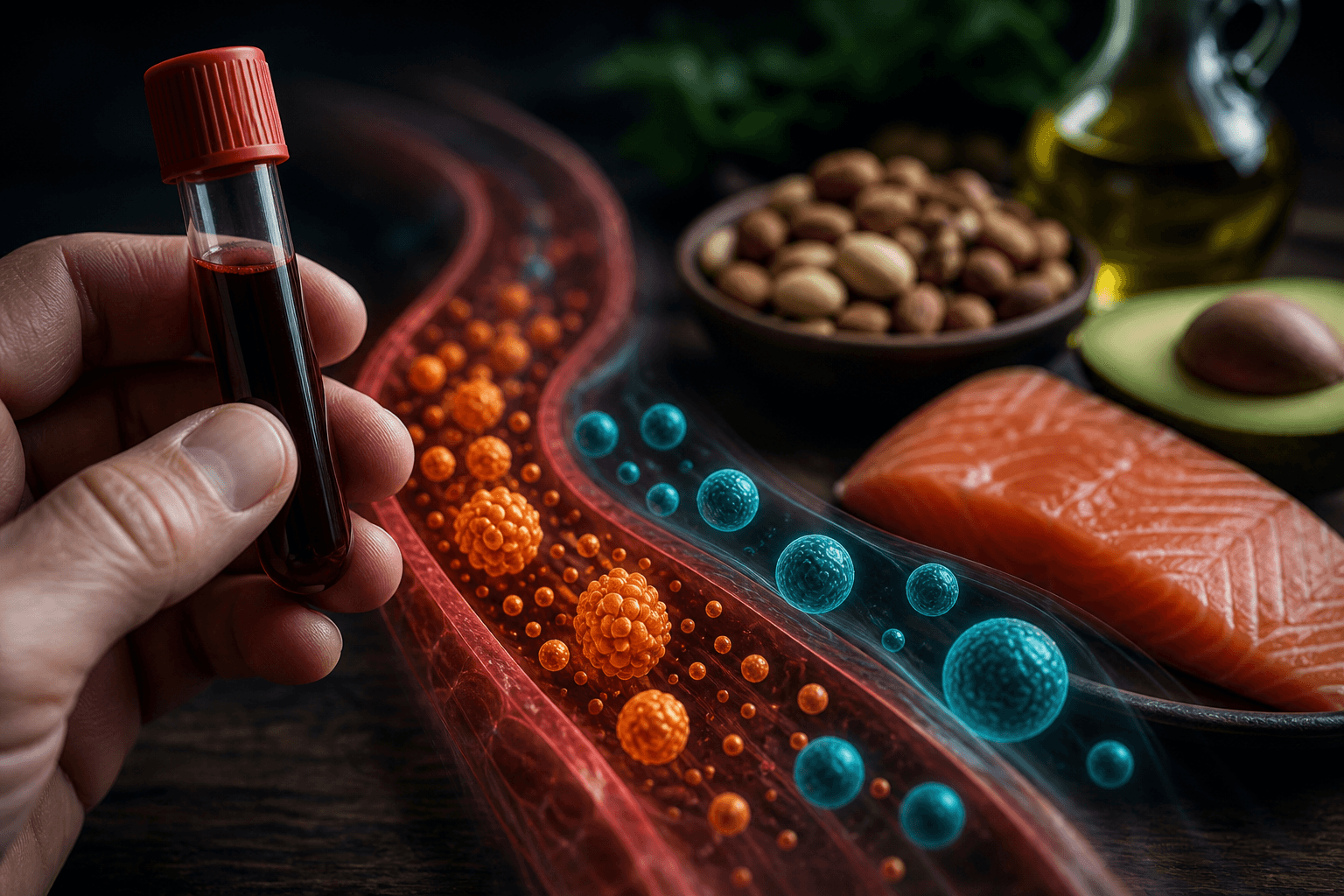
Cholesterol itself isn't the problem — your body needs it. The real risk lies in specific particle types, one largely genetic factor most standard panels don't even measure, and what actually happens at the artery wall.
Cholesterol has an image problem. It's essential for building cell membranes, producing hormones, synthesizing vitamin D, and making the bile acids that digest fat — none of which is possible without it. The actual cardiovascular risk isn't cholesterol existing in the blood; it's what happens when specific particles carrying it interact with already-damaged artery walls.
Where It Actually Goes Wrong
Atherosclerosis — the process behind most cardiovascular disease — begins when LDL particles penetrate small areas of damage in the artery's inner lining and become trapped. Once trapped, they're prone to oxidation, which triggers an immune response: white blood cells consume the oxidized particles and become "foam cells," which accumulate into the fatty streaks that eventually become plaque. Cholesterol circulating harmlessly in the bloodstream isn't the issue — cholesterol lodged in an artery wall, oxidized, and triggering inflammation is.
Why Particle Number Can Matter More Than the LDL Number Alone
Standard cholesterol panels report LDL as a concentration (mg/dL), but risk is arguably better predicted by how many LDL particles are circulating, since each particle carries a chance of penetrating the artery wall regardless of how much cholesterol it happens to be carrying. Two people can have the same LDL concentration but a different number of particles — one carrying more cholesterol in fewer, larger particles, the other carrying less cholesterol in many more, smaller particles. A test called ApoB (or, less directly, LDL particle number testing) captures this more precisely than standard LDL-C alone, and is increasingly used for anyone with risk factors that don't fully explain their cardiovascular risk on standard testing alone.
The Genetic Factor Most People Have Never Heard Of
Lipoprotein(a), or Lp(a), is a distinct particle that behaves similarly to LDL in promoting plaque formation but is also independently associated with clotting risk. Unlike LDL, Lp(a) levels are almost entirely determined genetically and barely respond to diet, exercise, or weight loss — meaning someone with an otherwise excellent lifestyle and normal standard cholesterol can still carry significantly elevated cardiovascular risk if their Lp(a) is high. Because it's genetically fixed, it typically only needs to be measured once in a lifetime, yet it's rarely included in routine panels unless specifically requested — making it one of the more overlooked pieces of the cardiovascular risk picture, particularly for anyone with a family history of early heart disease that seems otherwise unexplained.
HDL: More Complicated Than "Good Cholesterol"
HDL's traditional role is transporting excess cholesterol away from artery walls back to the liver, which is why higher levels are generally associated with lower risk. But research has increasingly shown that HDL function — how effectively it actually performs that transport role — matters more than the raw number, and very high HDL levels don't reliably translate to extra protection the way lower-to-moderate elevated levels do. This is part of why HDL is no longer viewed as simply "more is always better."
Triglycerides: The Often-Underweighted Number
Elevated triglycerides frequently get less attention than LDL, but they're closely tied to insulin resistance and are an independent cardiovascular risk factor, particularly when elevated alongside low HDL — a pattern common in metabolic syndrome. Triglycerides also tend to respond faster than LDL to changes in diet, alcohol intake, and weight, making them a useful marker for tracking whether lifestyle changes are having an effect in the short term.
What Actually Moves These Numbers
- Soluble fiber (oats, legumes, psyllium) binds cholesterol in the digestive tract and reduces LDL absorption directly.
- Replacing saturated fat sources with unsaturated ones (rather than simply removing fat) has a more consistent effect on LDL than fat reduction alone.
- Omega-3 fatty acids, particularly from fish, have their most consistent evidence for lowering triglycerides specifically.
- Regular aerobic exercise improves HDL function and helps lower triglycerides, often within a matter of weeks.
- Weight loss, even modest amounts, tends to improve triglycerides and HDL together, given their shared connection to insulin resistance.
When Medication Enters the Picture
Statins — such as atorvastatin (Lipitor) and rosuvastatin (Crestor) — remain the most widely used and studied medication class, working by reducing cholesterol production in the liver, which in turn increases the liver's uptake of LDL from the bloodstream. For people who need additional lowering beyond statins, or who can't tolerate them, other options exist — including ezetimibe (which reduces cholesterol absorption in the gut) and, for higher-risk individuals, PCSK9 inhibitors, a newer injectable class that can produce substantial additional LDL reduction. Which approach makes sense depends on overall cardiovascular risk, other health conditions, and how someone tolerates a given medication — a decision made individually with a healthcare provider.
Continue reading for free
Create a free account to keep reading — and connect with our trusted partner's licensed doctors whenever you need more than information.
Already have an account?