
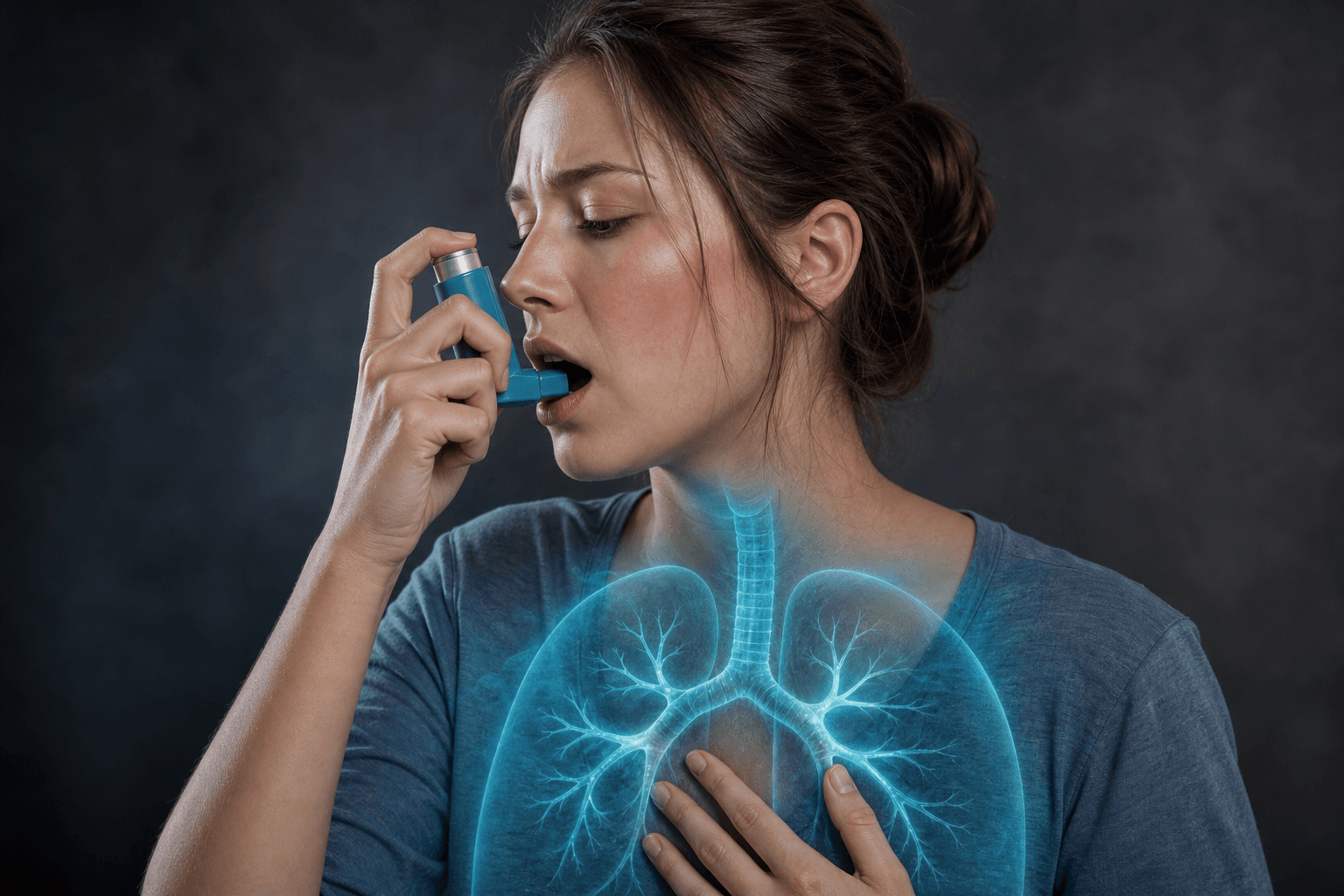
Asthma isn't only a childhood condition — it can develop for the first time well into adulthood, and adult-onset cases often follow a somewhat different pattern than the asthma most people picture.
Asthma is widely associated with childhood, but a meaningful proportion of asthma diagnoses occur for the first time in adulthood, sometimes in people with no prior history of breathing problems or allergies at all. Adult-onset asthma tends to follow a somewhat different pattern than the classic childhood, allergy-driven presentation — it's frequently more persistent, less clearly tied to specific allergens, and more likely to coexist with other respiratory conditions, which is part of why it's sometimes initially misdiagnosed as a persistent cold, bronchitis, or simple deconditioning.
What's Actually Happening in the Airways
Asthma involves chronic inflammation of the airways combined with heightened sensitivity (hyperresponsiveness) that causes the airway muscles to constrict too readily in response to various triggers. During an asthma flare, three things happen simultaneously: airway muscles tighten (bronchospasm), the airway lining becomes inflamed and swollen, and mucus production increases — all three narrowing the space available for air to move, which produces the characteristic wheeze, cough, chest tightness, and shortness of breath. Between flares, especially in mild or well-controlled asthma, airways can look and function close to normal, which is part of why asthma is sometimes underestimated by people who only experience symptoms intermittently.
Common Triggers Worth Identifying
Allergens — dust mites, pollen, pet dander, mold — remain common triggers even in adult-onset asthma, though a distinct allergic cause is identified less consistently than in childhood asthma. Respiratory infections are one of the most common triggers for flares in people who already have asthma, and can occasionally also serve as the initial event that unmasks previously undiagnosed adult asthma in someone with an underlying susceptibility. Exercise, cold air, strong odors or fumes, certain medications (including aspirin and other NSAIDs in a specific subset of asthma patients, and beta-blockers in some cases), and workplace exposures — dust, chemical fumes, certain occupational allergens — are all well-documented triggers, with occupational asthma specifically recognized as a distinct, important category worth identifying since removing the workplace exposure can be central to management.
Important
A sudden worsening of breathlessness that doesn't improve with a rescue inhaler, an inability to speak in full sentences due to breathlessness, blue-tinged lips or fingertips, or a peak flow reading significantly below a person's personal baseline are signs of a severe asthma attack requiring emergency care, not a flare to manage at home.
How Adult-Onset Asthma Is Diagnosed
Spirometry, a breathing test measuring how much and how quickly air can be exhaled, is the standard diagnostic tool, often performed before and after inhaling a bronchodilator medication to see whether airflow improves significantly — a positive response supports an asthma diagnosis. Because asthma symptoms can overlap significantly with other conditions, particularly in adults, testing also often aims to rule out or identify overlapping conditions such as chronic obstructive pulmonary disease (COPD, especially relevant in current or former smokers), vocal cord dysfunction, or heart-related causes of breathlessness, since treatment approaches for these differ meaningfully from standard asthma management.
Treatment: Controller and Reliever Medications Serve Different Roles
Asthma medications fall into two functionally distinct categories that are important to understand separately. Reliever (rescue) inhalers, typically containing a short-acting bronchodilator like salbutamol (Ventolin), act within minutes to relax airway muscles during an acute flare, but do nothing to address the underlying inflammation driving the condition. Controller medications, most commonly inhaled corticosteroids such as budesonide (Pulmicort) or fluticasone (Flixotide), taken daily regardless of symptoms, address that underlying inflammation over time and are the foundation of long-term asthma control — needing a rescue inhaler frequently despite regular controller use generally signals that the controller regimen needs adjustment, not simply that more rescue inhaler use is the solution. Montelukast (Singulair), a leukotriene receptor antagonist taken as a tablet, is sometimes added for specific trigger patterns, particularly exercise-induced or allergy-related symptoms, and for more severe, poorly controlled asthma, newer biologic medications targeting specific inflammatory pathways have significantly expanded treatment options in recent years.
Living Well With Adult Asthma
Well-controlled asthma should allow near-normal activity levels, including exercise, with minimal reliance on a rescue inhaler — frequent nighttime symptoms, activity limitation, or rescue inhaler use more than a couple of times a week generally indicate suboptimal control that's worth revisiting with a doctor rather than accepting as an unavoidable baseline. A written asthma action plan, developed with a doctor, that specifies what to do at different symptom levels (including when to increase controller medication temporarily and when to seek urgent care) is strongly associated with better outcomes and fewer emergency visits compared to managing flares reactively without a plan.