
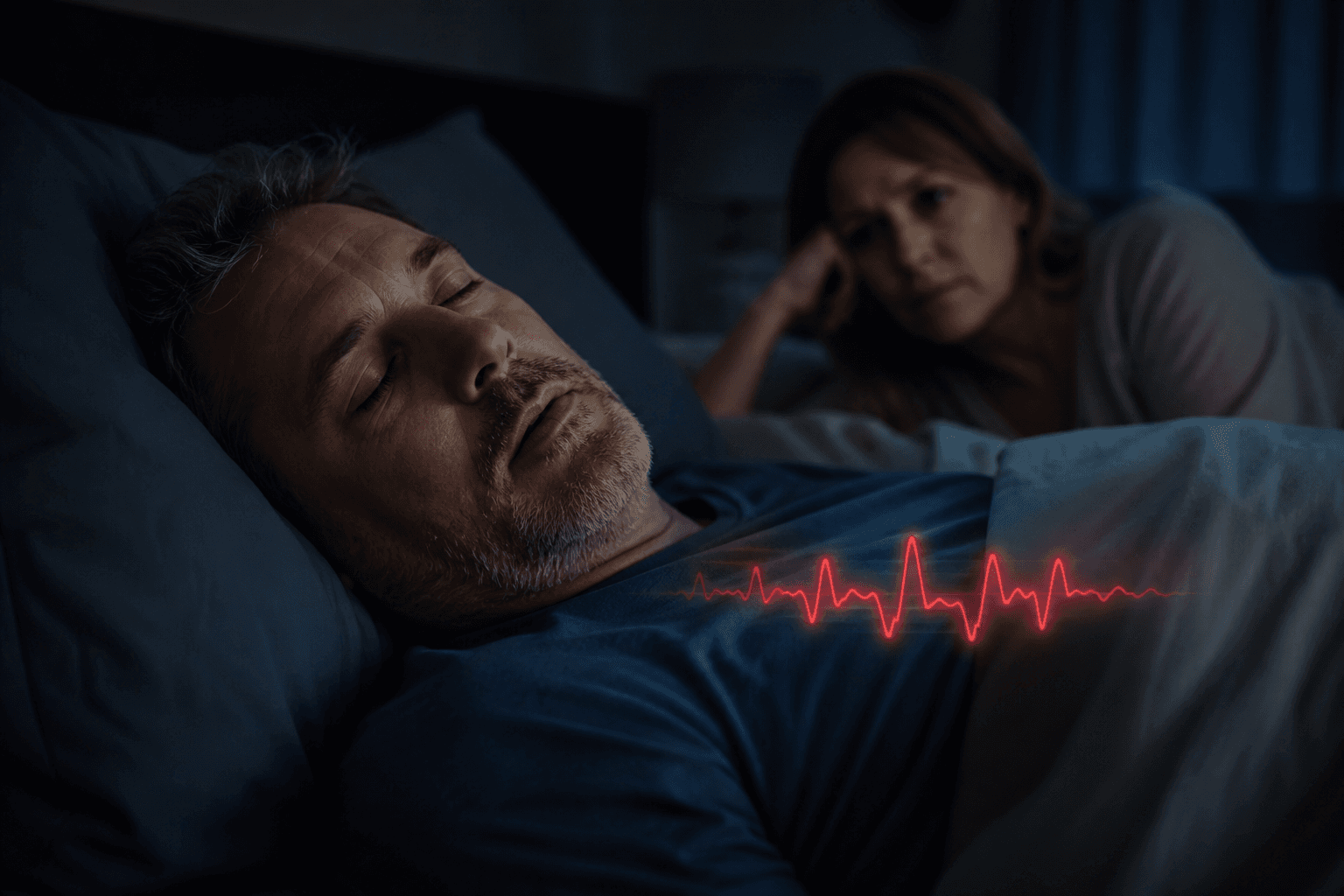
Snoring gets most of the attention, but sleep apnea's more telling signs often show up during the day — persistent fatigue, morning headaches and difficulty concentrating despite what feels like a full night's sleep.
Loud snoring is the symptom most commonly associated with sleep apnea, but it's an unreliable marker on its own — plenty of people snore loudly without having sleep apnea, and a meaningful proportion of people with genuine sleep apnea, particularly women, don't snore loudly or noticeably at all. The more diagnostically useful pattern isn't the snoring itself, but what happens during the day afterward: a night that felt, subjectively, like adequate sleep, followed by fatigue, brain fog, or headaches that don't match how much time was actually spent in bed.
What's Actually Happening During an Apnea Event
Obstructive sleep apnea (the most common form) occurs when the muscles supporting the soft tissue at the back of the throat relax during sleep to the point of partially or fully blocking the airway, repeatedly interrupting breathing throughout the night — sometimes dozens or even over a hundred times per hour in more severe cases, each pause typically lasting ten seconds or longer. Each pause causes blood oxygen levels to drop, which triggers a brief arousal (often not a full awakening the person remembers) as the brain restores muscle tone to reopen the airway. This repeated cycle of oxygen drops and micro-arousals is what fragments sleep quality so significantly, even in someone who technically spent seven or eight hours in bed and has no memory of waking up throughout the night.
The Daytime Symptoms That Are Easy to Misattribute
Excessive daytime sleepiness — genuinely struggling to stay awake during quiet activities like reading, watching television, or, in more severe cases, even while driving — is one of the more specific indicators of sleep apnea, distinct from ordinary tiredness. Morning headaches, caused by the repeated overnight drops in blood oxygen and corresponding rises in carbon dioxide, are another frequently overlooked clue, as is difficulty concentrating, memory lapses, and irritability that can easily be misattributed to stress, aging, or an unrelated mood issue rather than connected back to fragmented, poor-quality sleep.
Tip
A useful, low-effort self-check is comparing how rested you feel after a full night's sleep to how rested you'd expect to feel given the hours logged — a persistent, unexplained mismatch between the two, especially alongside snoring reported by a partner, is a reasonable trigger to bring the topic up with a doctor.
Why Sleep Apnea Is a Cardiovascular Concern, Not Just a Sleep Issue
Each apnea event triggers a surge of stress hormones and a spike in blood pressure as the body responds to the oxygen drop, and this repeated nightly pattern is strongly associated with a meaningfully increased long-term risk of high blood pressure, irregular heart rhythms (particularly atrial fibrillation), heart failure, and stroke. This cardiovascular connection is a significant part of why sleep apnea is treated as a medical condition warranting proper diagnosis and management, rather than simply an inconvenience affecting sleep quality and daytime alertness alone.
Who's at Higher Risk
Excess weight, particularly fat distribution around the neck and upper airway, is one of the strongest risk factors, since it directly narrows the available airway space. A neck circumference above roughly 40cm in men is a commonly used clinical flag. Anatomical factors — a naturally narrow airway, enlarged tonsils, or a recessed jaw — increase risk independent of body weight, which is part of why sleep apnea can occur in people who aren't overweight at all. Risk also increases with age, male sex (though the gap narrows significantly after menopause), family history, alcohol use before bed (which further relaxes throat muscles), and smoking.
How It's Diagnosed and Treated
A sleep study — either conducted overnight in a dedicated sleep lab or increasingly through validated home testing devices — measures breathing patterns, oxygen levels, and the frequency of apnea events to confirm diagnosis and assess severity, typically expressed as the number of apnea/hypopnea events per hour of sleep. Continuous positive airway pressure (CPAP) therapy, which delivers a steady stream of air through a mask to keep the airway open throughout the night, remains the most effective and well-studied treatment for moderate-to-severe cases, with many users reporting a genuinely dramatic improvement in daytime energy and concentration within days of consistent use. For milder cases or specific anatomical causes, oral appliances that reposition the jaw, weight loss where relevant, positional therapy, or, in select cases, surgery are alternative or complementary approaches.