
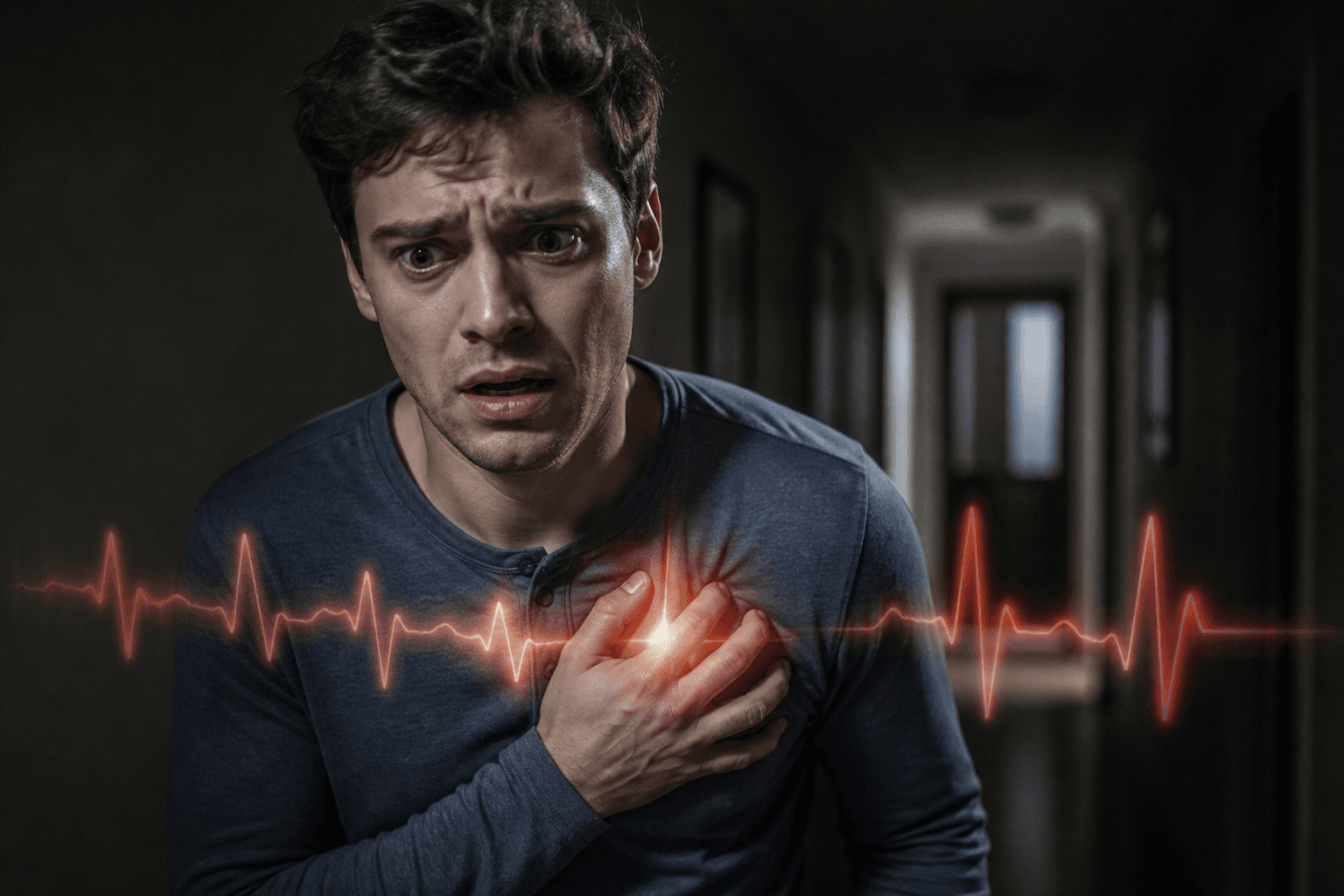
A panic attack has a predictable shape — a sharp rise, a peak, and a decline — and knowing that shape in advance, along with a few concrete in-the-moment steps, can make an episode considerably more survivable.
The single most disorienting part of a first panic attack is usually the certainty that something catastrophic is happening physically — a heart attack, a stroke, losing control entirely — combined with a total absence of any information suggesting otherwise. Knowing what a panic attack actually feels like, minute by minute, and having a short list of concrete actions ready in advance, changes the experience considerably, even though it doesn't eliminate it outright.
The Minute-by-Minute Shape of an Attack
Panic attacks follow a remarkably consistent physiological timeline. Onset is abrupt, often without an identifiable trigger, and symptoms typically build to their peak within about ten minutes. During that peak, the most common symptoms include a racing or pounding heart, chest tightness or pain, shortness of breath or a smothering sensation, trembling, sweating, nausea, dizziness or lightheadedness, tingling in the hands, feet or face, chills or hot flashes, and a frightening sense of unreality or detachment from one's own body known as depersonalization. After the peak, symptoms generally begin to subside within twenty to thirty minutes, even without any intervention — this decline is a physiological certainty, not a matter of willpower, which is worth holding onto during the worst of an episode.
Why It Can Feel Exactly Like a Cardiac Emergency
The overlap between panic attack symptoms and cardiac symptoms isn't coincidental — both involve the sympathetic nervous system's fight-or-flight activation, which floods the body with adrenaline, accelerates heart rate, and redirects blood flow away from the digestive system, producing genuine chest tightness and breathlessness. This is precisely why a large proportion of first-time panic attacks result in an emergency department visit, and why that response is entirely reasonable rather than an overreaction — chest pain and breathing difficulty should always be medically evaluated the first time they occur, or if their character changes from a person's usual pattern, since panic attacks and cardiac events can genuinely be difficult to distinguish from the inside.
Important
New, severe chest pain — especially with pain radiating to the arm or jaw, or accompanied by cold sweat and nausea rather than the more diffuse anxiety symptoms described above — should always be treated as a possible cardiac emergency until medically ruled out, even in someone with a known history of panic attacks.
A Practical Step-by-Step Approach During an Episode
Slowing the breath is usually the single most effective in-the-moment tool, specifically by making the exhale longer than the inhale (for example, inhaling for four seconds and exhaling for six to eight), since rapid shallow breathing itself perpetuates several of the physical sensations — lightheadedness, tingling — that make an attack feel worse. Grounding techniques work by deliberately shifting attention away from internal catastrophic thoughts toward concrete external sensory input: naming five things that can be seen, four that can be heard, three that can be physically felt, in turn. Naming what's happening out loud or internally — "this is a panic attack, it will peak and then pass, I am not in danger" — uses the same principle, giving the rational part of the brain something concrete to hold onto while the physiological surge runs its course. Trying to fight the sensations or urgently escape the situation tends to prolong the attack in many cases, whereas allowing it to run its natural, time-limited course, while using these grounding tools, generally shortens the experience.
What Happens After the Peak
As adrenaline clears, the body typically moves into a rebound phase involving fatigue, sometimes described as feeling "wrung out," along with residual jitteriness or a lingering sense of unease that can last for hours after the acute symptoms have resolved. This after-effect is a normal part of the physiological cycle and isn't a sign that another attack is imminent, though many people interpret residual jitteriness this way, which can itself trigger anticipatory anxiety and, in some cases, another attack — this is the beginning of what's clinically described as the fear-of-fear cycle.
When a Pattern of Panic Attacks Needs Professional Support
A single, isolated panic attack during an unusually stressful period doesn't necessarily require ongoing treatment. Recurring attacks — particularly when accompanied by persistent worry about having another one, or by avoidance of places or situations associated with a previous attack — meet the clinical threshold for panic disorder, which responds well to cognitive behavioral therapy specifically focused on interrupting the fear-of-fear cycle, sometimes combined with medication such as an SSRI for longer-term management or a short-acting benzodiazepine for situational use, prescribed and monitored by a clinician.