
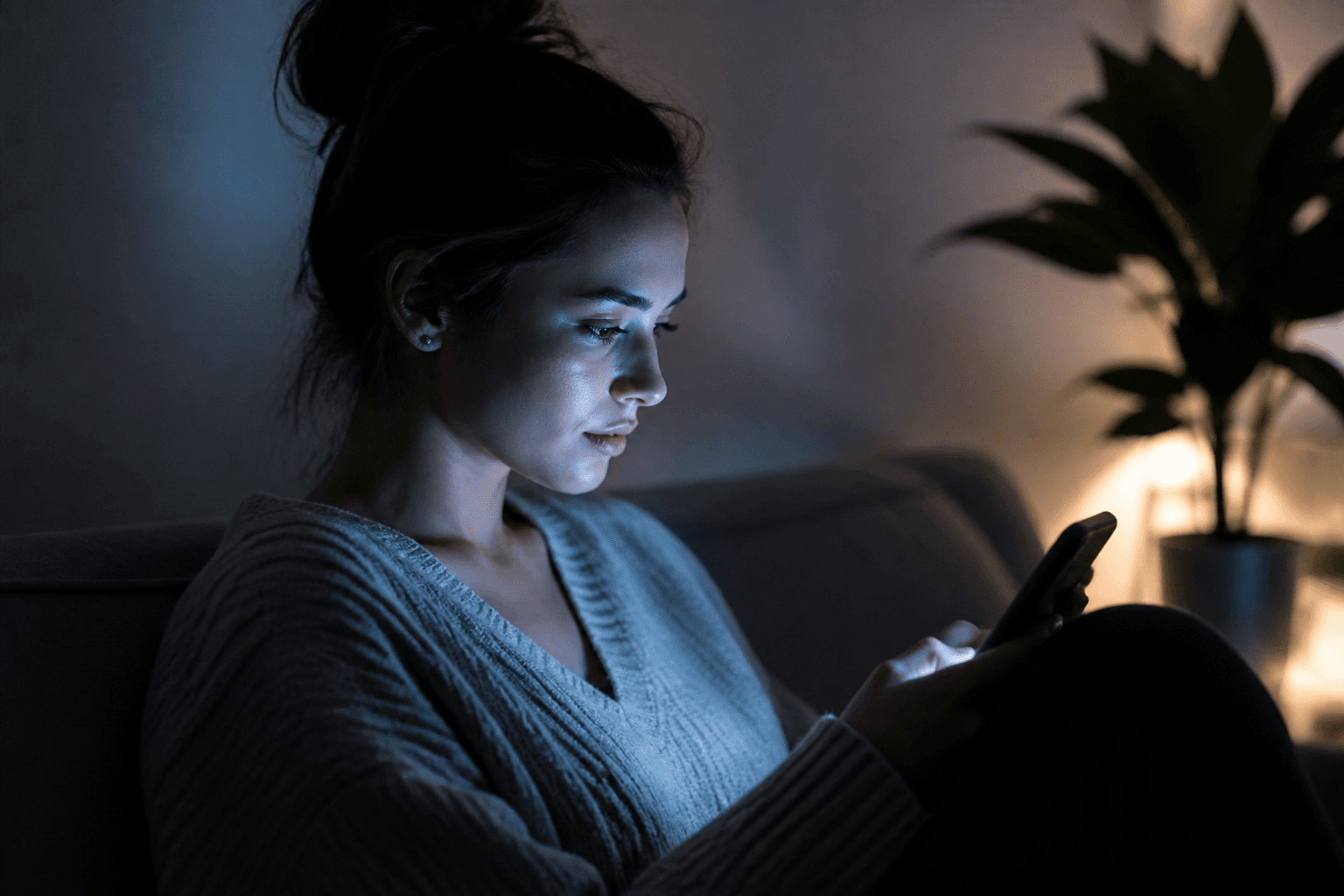
Blue light from screens does affect melatonin, but the size of that effect — and how much it actually matters for sleep — is often exaggerated compared to what the evidence shows.
Blue-light-blocking glasses have become a genuine consumer category, night mode is now a default setting on nearly every phone, and "put the phone away before bed" has become one of the most repeated pieces of sleep advice around. The underlying biology is real — blue wavelengths do suppress melatonin more than other colors of light — but the size of that effect, and how much it actually explains typical sleep problems, is considerably more modest than the popular narrative suggests.
Why Blue Wavelengths Specifically Affect the Body's Clock
The retina contains specialized light-sensitive cells, distinct from the rods and cones used for vision, that are particularly responsive to blue wavelengths in the range of roughly 460-480 nanometers. These cells feed directly into the brain's master circadian clock, the suprachiasmatic nucleus, which uses that signal to help regulate the timing of melatonin release. This is a genuinely useful system during the day — it's part of how the brain distinguishes daytime from nighttime — but it means that exposure to blue-rich light in the evening can send a "it's still daytime" signal that delays the natural rise of melatonin.
What the Research Actually Shows About Screens
Where the popular narrative tends to overreach is in treating a smartphone or laptop screen as equivalent to a stadium floodlight. Screens emit far less total light than sitting under indoor room lighting or, especially, outdoor daylight, and several studies suggest that the delay in melatonin onset from typical evening screen use is measurable but modest — often a matter of minutes rather than hours — for most people using screens at typical brightness and viewing distance. The psychological and behavioral aspects of screen use before bed — stimulating content, stressful news, doom-scrolling, or simply staying up later because of engaging content — likely play at least as large a role in disrupted sleep as the light itself.
Do Blue-Light-Blocking Glasses and Night Mode Actually Help?
Night mode settings, which shift a screen's color temperature toward warmer, less blue-heavy tones, have shown mixed results in research — some studies find a modest benefit for melatonin levels, while others find no significant difference compared to standard screen settings, particularly at typical evening brightness levels. Blue-light-blocking glasses show a similarly mixed picture: they may offer a small benefit for people who are especially light-sensitive or who use screens at high brightness for long stretches close to bedtime, but they're unlikely to be a complete solution on their own, especially if screen time itself is displacing time that would otherwise be spent winding down.
Total Light Exposure Matters More Than Color Alone
Total brightness (often measured in lux) appears to matter at least as much as the specific wavelength composition of the light. A dim, warm-toned lamp used at close range can, in some cases, suppress melatonin more than a bright but distant screen, simply because of how much total light reaches the eye. This is part of why blanket advice to "avoid all screens before bed" can miss the bigger picture — dimming overall room lighting in the evening, regardless of source, is likely to have a more meaningful effect than obsessing over the color temperature of a single device.
Practical Steps That Are Actually Supported by Evidence
Note
Reducing overall evening light exposure, lowering screen brightness, and holding screens farther from the face all reduce the total light dose reaching the eye more reliably than color-shifting filters alone.
For most people, the content and timing of screen use — scrolling in bed until well past a planned bedtime — matters more for sleep than the blue light itself.
Beyond adjusting screens, dimming overhead lights in the hour or so before bed, using warmer-toned lamps in the evening, and being mindful of overall time spent on stimulating content rather than passive, low-arousal activities are all reasonable, evidence-aligned steps. None of these need to be treated as strict rules; the goal is reducing unnecessary light and mental stimulation in the window before sleep, not eliminating screens entirely.
When Screen Habits Aren't the Real Issue
For people who continue to struggle with sleep despite reasonable adjustments to evening light and screen use, it's worth considering that blue light was likely never the primary driver of the problem. Chronic stress, an irregular schedule, an underlying sleep disorder, or a mismatch between someone's natural circadian tendency (chronotype) and their required schedule are all more substantial contributors for many people, and these are worth discussing with a doctor if sleep difficulty persists despite reasonable habit changes.