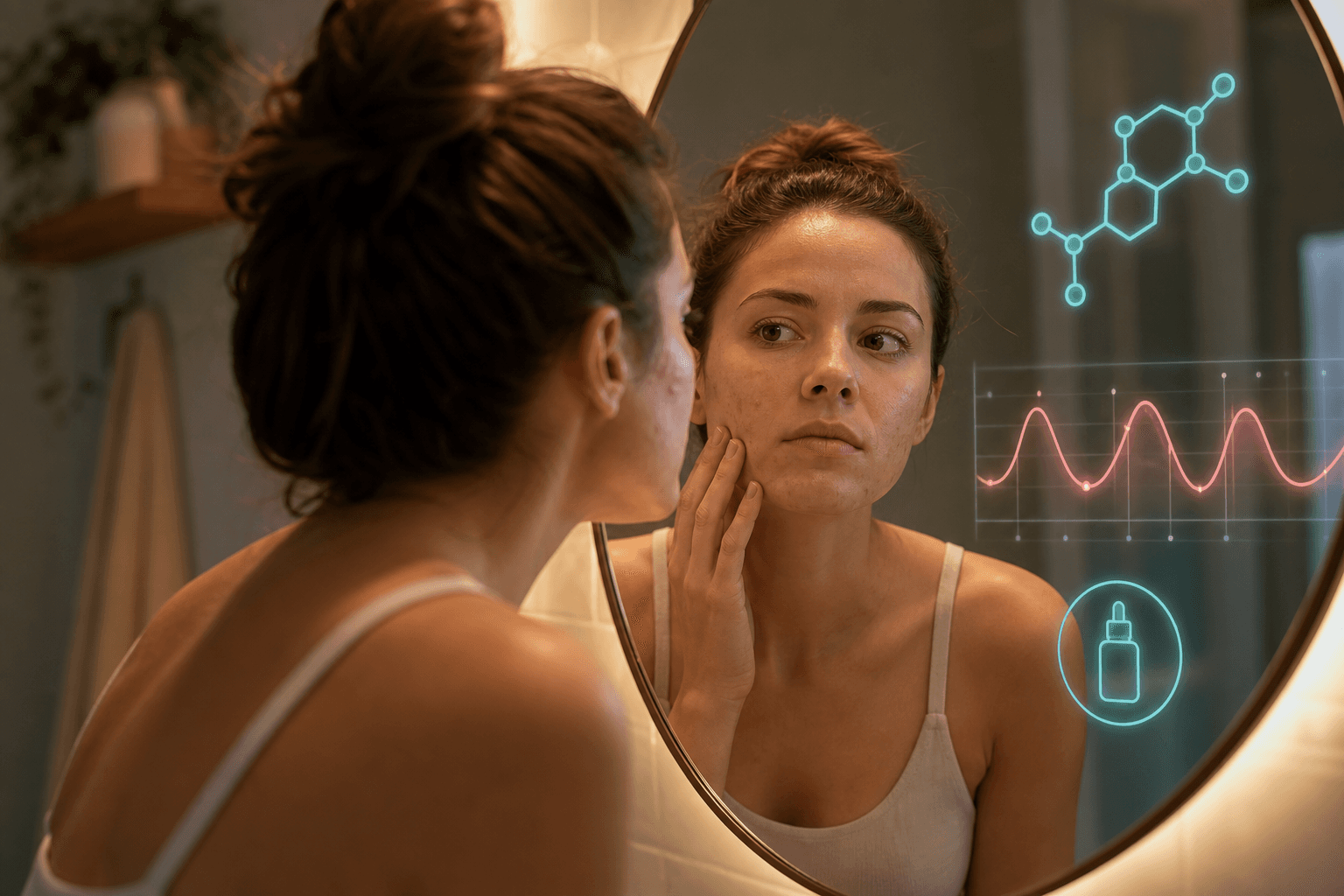
Adult acne often isn't leftover teenage acne at all — it frequently follows a distinct jawline pattern driven by hormonal fluctuation, which is exactly why it tends to flare on a monthly cycle and resist typical over-the-counter treatment.
A large number of adults dealing with acne in their twenties, thirties, or even forties never had significant acne as teenagers — this isn't leftover adolescent skin trouble persisting into adulthood, but frequently a distinct condition with its own pattern, its own timing, and its own underlying driver.
A Different Pattern Than Teenage Acne
Teenage acne tends to concentrate on the forehead and nose (the oilier "T-zone"). Adult acne, particularly in women, much more commonly appears along the jawline, chin, and lower cheeks — a distribution specific enough that it's often referred to informally as "hormonal acne." This isn't a coincidence of geography; it reflects a genuine difference in the underlying mechanism.
The Hormonal Mechanism Behind the Jawline Pattern
Sebaceous (oil) glands along the jawline and chin are particularly sensitive to androgens — a category of hormones present in everyone, regardless of sex, in varying amounts. Androgens increase sebum production and change its composition in ways that make it more likely to clog pores and support the bacteria associated with acne. Because these particular glands are especially androgen-responsive, they tend to be affected disproportionately when hormone levels shift, even modestly.
Why It Often Gets Worse Right Before a Period
In the luteal phase — the second half of the menstrual cycle — progesterone rises and estrogen falls, shifting the relative balance toward greater androgen influence on the skin. This is the direct explanation for the very common pattern of breakouts flaring in the week or so before a period and calming down again afterward — a cyclical pattern that's a strong indicator of a hormonal driver, distinct from acne triggered by a new skincare product or diet change.
PCOS as an Underlying Driver Worth Ruling Out
When jawline acne is persistent, resistant to typical treatment, and accompanied by irregular periods, excess hair growth, or other signs of androgen excess, polycystic ovary syndrome (PCOS) is a reasonable condition to rule out, since it directly involves elevated androgen levels and is a well-established cause of exactly this acne pattern. Identifying PCOS, where present, often changes the treatment approach considerably, since addressing the underlying hormonal driver tends to be more effective than treating the skin in isolation.
Non-Hormonal Contributing Factors
- Chronic stress raises cortisol, which independently increases sebum production and can worsen acne regardless of hormonal cycling.
- Occlusive skincare and hair products — heavier moisturizers, certain sunscreens, and hair products that migrate onto the jawline and hairline — are a commonly overlooked contributor to breakouts in exactly this area.
- Diet has a more individualized and debated role; some research links high-glycemic-index foods and dairy to acne severity in certain individuals, though the effect varies considerably from person to person rather than applying universally.
Why It "Keeps Coming Back" Despite Treatment
Treating active breakouts with a spot treatment addresses the visible result without touching whatever is driving new breakouts to form in the first place. For acne with a significant hormonal component, this means the cycle resets each month regardless of how well any individual breakout is treated — which is the core reason many people describe adult acne as persistent despite trying multiple over-the-counter products.
Treatment Approaches Matched to the Underlying Cause
- Topical retinoids are generally a first-line option, working by normalizing skin cell turnover and preventing pores from becoming clogged in the first place.
- Benzoyl peroxide and salicylic acid target the bacterial and clogging components directly and are commonly used alongside retinoids.
- Certain hormonal contraceptives can meaningfully reduce hormonally driven acne by stabilizing the cyclical hormone fluctuation described above.
- Spironolactone, a medication with anti-androgen effects, is commonly used specifically for jawline-pattern hormonal acne in women who aren't good candidates for or don't respond sufficiently to other treatments.
- Isotretinoin is reserved for severe, treatment-resistant cases and requires close medical supervision given its more significant side effect profile.
Continue reading for free
Create a free account to keep reading — and connect with our trusted partner's licensed doctors whenever you need more than information.
Already have an account?