Skin cancer is highly treatable when caught early, and a simple monthly self-check using a well-established visual checklist can catch changes worth showing a doctor long before they become dangerous.
Skin cancer is the most commonly diagnosed cancer overall, and it's also one of the most visually accessible for early detection, since the affected tissue is directly visible without any imaging or invasive procedure required — which makes a structured self-examination genuinely one of the highest-value, lowest-cost screening habits available for any health condition.
The Three Main Types and Why the Distinction Matters
Basal cell carcinoma is the most common type, tends to grow slowly, and rarely spreads beyond the skin, but can cause significant local tissue damage if left untreated for a long time, often appearing as a pearly or waxy bump, a flat flesh-colored or brown scar-like lesion, or a sore that doesn't heal. Squamous cell carcinoma is the second most common type, grows somewhat more quickly, and carries a higher (though still relatively low) risk of spreading if untreated, often presenting as a firm red nodule or a flat lesion with a scaly, crusted surface. Melanoma, while less common than the other two, is significantly more dangerous because of its higher tendency to spread to other organs, which is exactly why melanoma-specific warning signs get particular attention in screening guidelines and why early detection specifically for this type has an outsized impact on survival outcomes.
The ABCDE Rule for Checking Moles
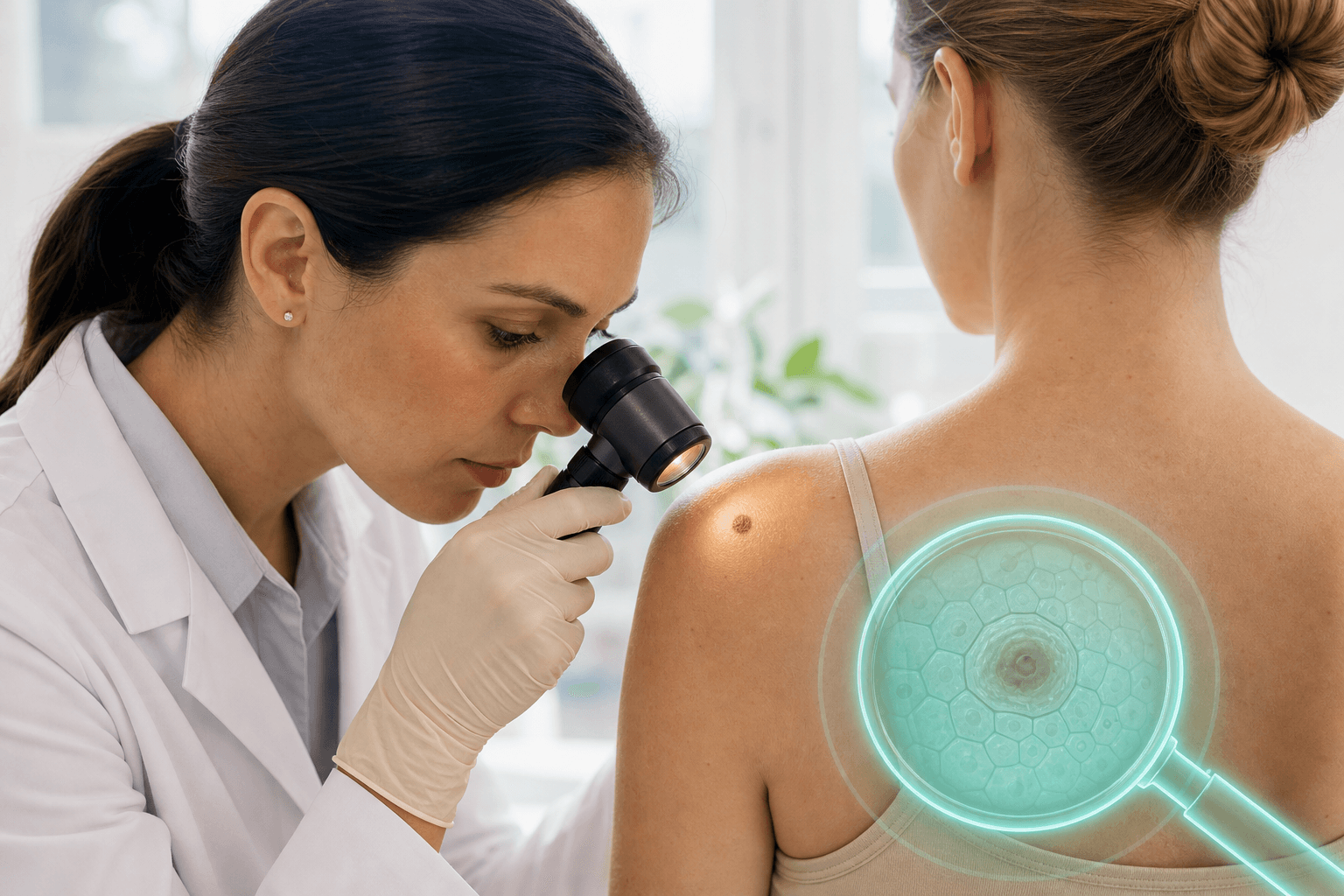
Dermatologists commonly teach the ABCDE framework for evaluating a mole or pigmented spot for melanoma warning signs: Asymmetry (one half doesn't match the other), Border irregularity (edges that are notched, blurred, or poorly defined rather than smooth), Color variation (multiple colors or shades within the same lesion, rather than one uniform color), Diameter (generally greater than 6mm, roughly the size of a pencil eraser, though melanomas can occasionally be smaller), and Evolution (any change in size, shape, color, or symptoms like itching or bleeding over time). Evolution is increasingly emphasized as one of the single most important criteria, since a mole that's genuinely changing is a more reliable warning sign than any static feature considered alone.
Tip
Taking a dated photo of any mole being monitored, using a consistent angle and lighting, makes it considerably easier to objectively judge whether it's actually changing over subsequent months, rather than relying on memory alone.
The "Ugly Duckling" Sign
Beyond the ABCDE criteria, dermatologists often use a simpler heuristic called the "ugly duckling" sign: a mole that looks visibly different from all the other moles on a person's body is worth particular attention, even if it doesn't clearly meet several ABCDE criteria individually. Most people have moles that share a broadly similar pattern of size, color, and shape, and a lesion that stands out from that personal pattern — rather than matching any fixed external standard — is a genuinely useful and fairly intuitive red flag to watch for during a self-check.
How to Actually Perform a Self-Examination
A thorough self-exam covers the entire body, including areas that are easy to overlook: the scalp (using a mirror or asking someone else to check), between the toes and on the soles of the feet, the back (using two mirrors or a partner's help), behind the ears, and the buttocks and genital area, since melanoma can develop in sun-protected areas as well, not exclusively in sun-exposed skin. Performing this check monthly, in good lighting, and comparing to what was noticed the previous month is generally sufficient for most people, with more frequent checks reasonable for those with a personal or family history of skin cancer or a large number of moles.
Risk Factors Worth Knowing
Cumulative and intense intermittent sun exposure (notably sunburns, particularly during childhood and adolescence) is the strongest modifiable risk factor for all three main skin cancer types. Fair skin, light-colored eyes, a large number of moles (more than 50), a personal or family history of skin cancer, a weakened immune system, and a history of indoor tanning bed use all increase risk independently of current sun exposure habits. Sunscreen use, protective clothing, and avoiding peak UV hours meaningfully reduce future risk, though existing sun damage from earlier in life remains a relevant risk factor that ongoing sun protection can't fully erase, which is part of why regular screening remains valuable even for someone who has since become diligent about sun protection.