
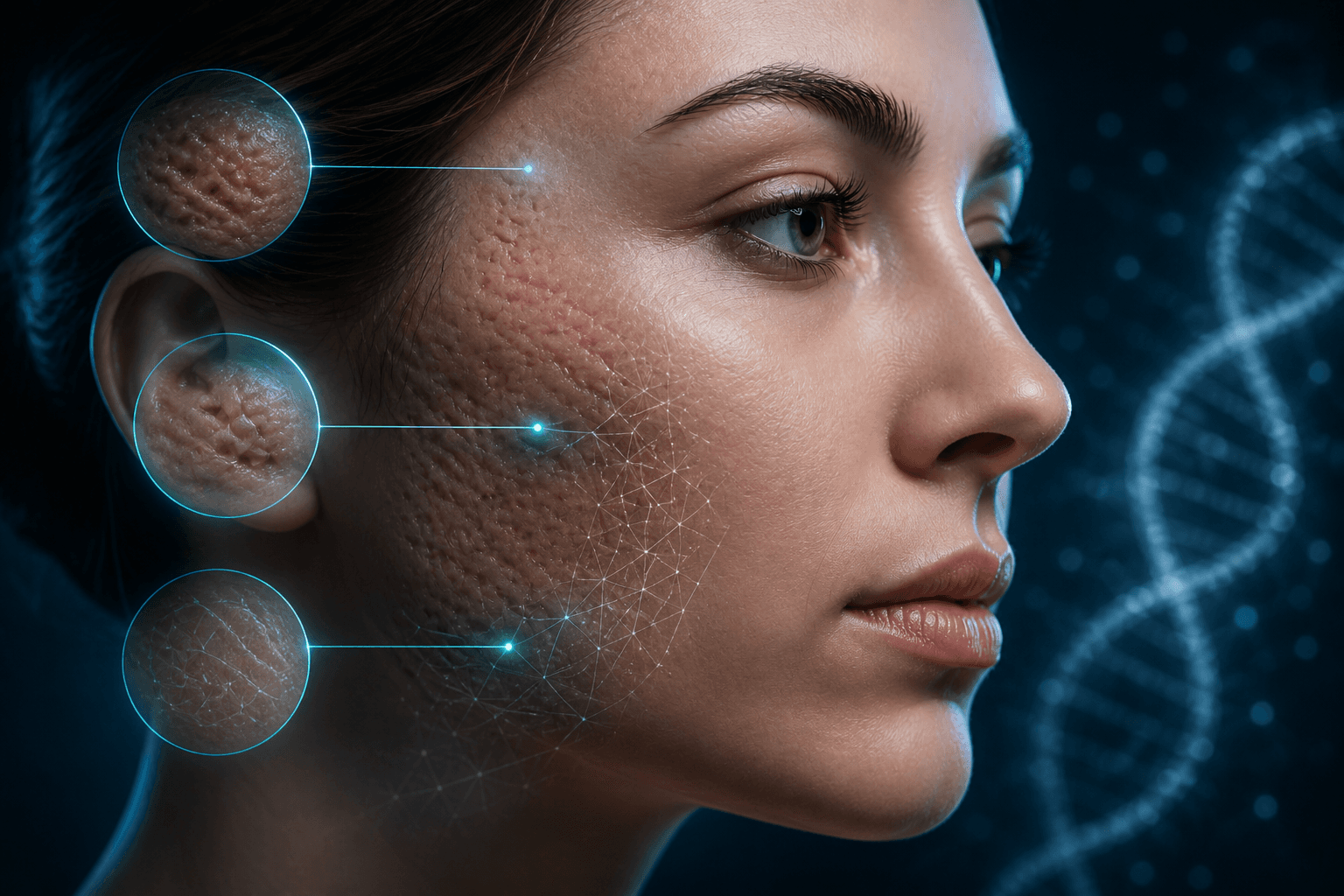
Acne scarring follows a predictable biological pattern. Here's what actually determines whether a breakout scars, and which treatments match each scar type.
Roughly one in five people who've experienced moderate to severe acne will go on to develop visible scarring — and for many, those marks outlast the breakouts themselves by years, sometimes decades. What's less well known is that the type of scar you end up with is decided within the first few weeks of inflammation, long before you ever notice a mark. By the time treatment starts, the skin has usually already made its decision.
That's the frustrating part. But it's also the useful part, because it means scarring isn't random — it follows a fairly predictable biological pattern, and understanding that pattern changes how you prevent and treat it.
Why Some Breakouts Scar and Others Don't
Every inflamed pimple triggers a wound-healing response in the deeper layers of skin. Normally, the body clears damaged tissue and rebuilds collagen in an organized grid — that's what keeps skin smooth. Acne complicates this process because the inflammation often reaches deeper than a typical cut or scrape, damaging the collagen-producing structures themselves.
When that happens, the skin rebuilds unevenly. Too little collagen in the repair leaves a depression. Too much, piled up in the wrong pattern, leaves a raised lump. Which one happens — and how visible it ends up being — depends heavily on how deep the inflammation went and how long it lasted before it was treated. This is why a single deep, cystic breakout left untreated for six weeks tends to scar far more than ten smaller pimples that clear within days.
The Two Categories You're Actually Dealing With
Most people lump "acne scars" into one category, but dermatologists generally separate them into two very different problems that respond to different treatments:
Atrophic scars (the depressions, which make up roughly 80–90% of acne scarring) come in three distinct shapes:
- Icepick scars — narrow, deep, and almost puncture-like, usually from severely inflamed cysts.
- Boxcar scars — wider, with sharply defined edges, giving skin a slightly pitted look.
- Rolling scars — broad and shallow with soft, wave-like edges caused by bands of scar tissue tethering the skin from below.
Hypertrophic and keloid scars are the opposite problem — raised, thickened tissue from an overactive healing response. These are far less common on the face and appear more often on the chest, back, and jawline.
Knowing which type you have matters more than most skincare advice suggests, because a treatment that works beautifully on rolling scars can do almost nothing for icepick scars — more on that below.
Diet's Role Is Real, But Modest
Nutrition doesn't cause or cure scarring directly, but it does influence how well skin repairs itself during the weeks when the scar is still forming. A few nutrients have decent evidence behind them:
- Zinc supports the enzymes involved in collagen remodeling and has been shown in small clinical trials to modestly reduce inflammatory acne lesion counts when taken consistently over 8–12 weeks.
- Omega-3 fatty acids shift the body's inflammatory signaling pathway, which is relevant because prolonged inflammation is precisely what deepens scarring.
- Vitamin C is a required cofactor for collagen synthesis — without adequate levels, the skin literally cannot build new collagen properly, regardless of what topical products you use.
There's also a less-discussed factor: diets high in refined sugar and dairy have been associated with more severe inflammatory acne in several observational studies, which indirectly raises scarring risk simply by increasing the number and severity of breakouts in the first place.
What Actually Reduces New Scarring — Beyond "Don't Pick"
Everyone's heard "don't pick your skin." True, but incomplete. A few less obvious habits matter just as much:
- The first two weeks of a breakout are the critical window. Getting inflammation under control quickly — rather than waiting to see if it "goes away" — is the single biggest lever for preventing a scar from forming at all.
- Non-comedogenic doesn't mean gentle enough. Many products labeled non-comedogenic still contain fragrance or alcohol-based ingredients that re-irritate already-inflamed skin, prolonging the healing phase.
- Daily broad-spectrum SPF 30+ isn't just about sunburn. UV exposure specifically darkens the pigmentation that often lingers after a scar has technically healed, making a fading mark look "stuck" for far longer than it would otherwise.
- Ingredients that quietly help: niacinamide (reduces post-inflammatory redness), azelaic acid (mild but effective on both active acne and discoloration), and low-strength retinoids used consistently rather than sporadically.
Matching Treatment to Scar Type
This is where most generic advice falls short — because the treatments below aren't interchangeable.
For icepick scars, surface-level treatments rarely make a meaningful difference since the damage runs deep and narrow. TCA CROSS (a targeted chemical treatment applied only to the scar itself) and fractional laser resurfacing tend to show the most measurable improvement.
For rolling scars, the underlying tethered tissue has to be released first — a minor in-office procedure called subcision — often combined with dermal fillers or your body's own collagen response from microneedling to keep the skin lifted afterward.
For boxcar scars, a combination approach tends to work best: laser resurfacing to soften the sharp edges, paired with microneedling over several sessions to gradually rebuild collagen density underneath.
Continue reading for free
Create a free account to keep reading — and connect with our trusted partner's licensed doctors whenever you need more than information.
Already have an account?